A supplier can show you a gorgeous rate deck, a slick portal, and a sales rep who swears their routes are Tier-1. None of it tells you whether a single call will connect.
Two numbers do. You can read both off your own CDRs, and together they end the argument.
ASR: does the call connect?
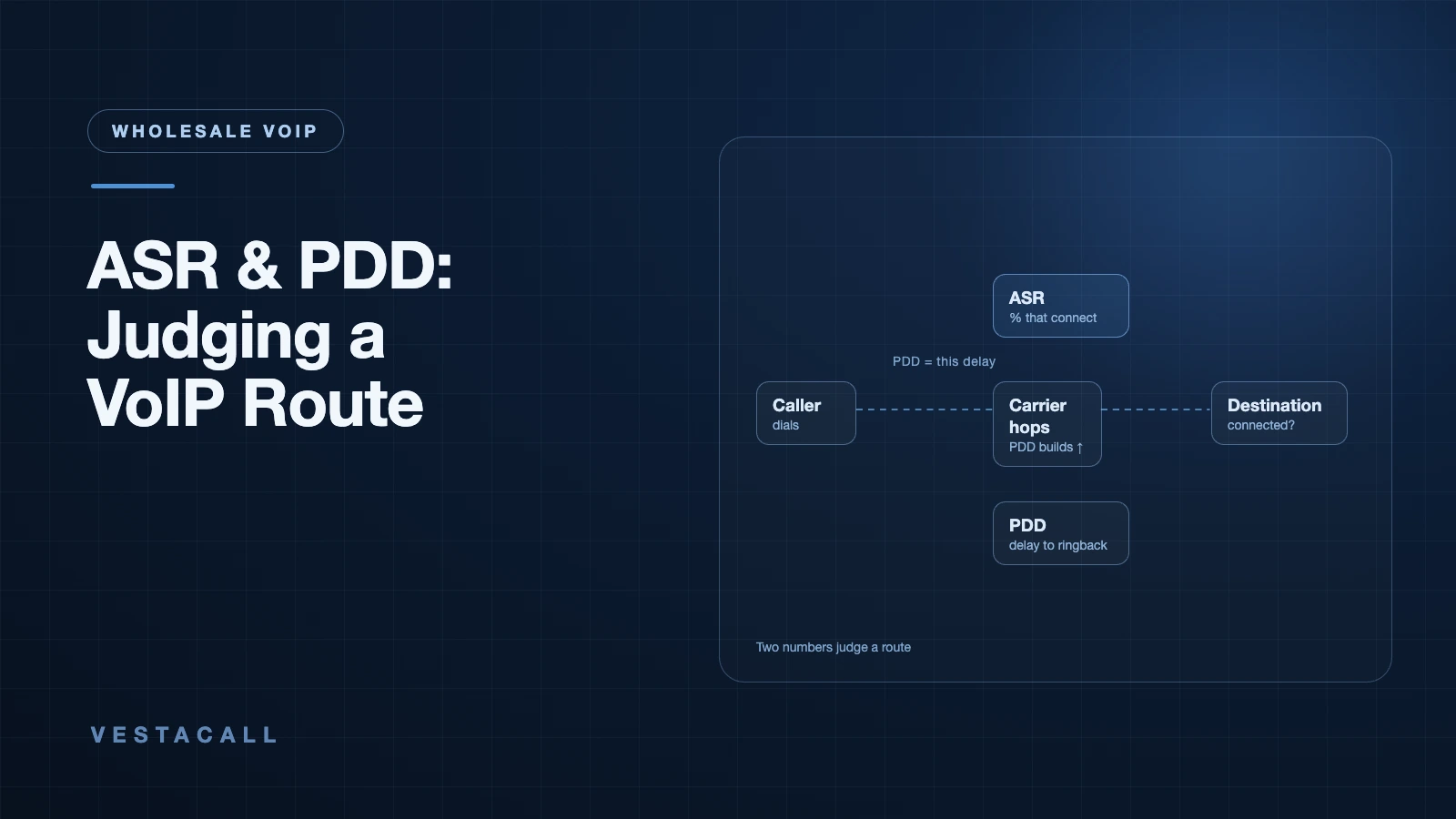
ASR — Answer-Seizure Ratio — is the share of call attempts that reach an answered call. Answered calls, divided by total attempts, as a percentage. It’s the single most important sign of whether a route works.
The trap is treating ASR as an absolute. A “good” ASR for one destination is a red flag in another — wrong numbers, unanswered phones, and local calling habits all cap it differently. So don’t chase a magic number.
Chase the trend. A prefix that sat at a steady ASR for weeks and then dropped overnight isn’t a dialing problem — it’s a route problem. Something changed upstream: a supplier swapped your route, a carrier started blocking, capacity ran out. The baseline is noise; the sudden move is the signal.
PDD: how long before anything happens?
PDD — Post-Dial Delay — is the gap between finishing dialing and hearing ringback. The dead air where the caller wonders if the call failed.
That pause is call setup propagating across every carrier hop between you and the destination. A direct route feels instant. A call hopping through four resold intermediaries can take several seconds — and in those seconds, impatient callers and auto-dialers give up.
Which is why PDD isn’t a standalone problem. Long PDD feeds low ASR: people hang up before the connection completes, so the call that would have answered never counts. When you see PDD creeping up and ASR sliding down together, you’re looking at one cause with two symptoms.
The cause is almost always hops
Here’s the thing both metrics are really measuring: how many hands your call passes through.
Every intermediary in a least-cost-routing chain adds delay (PDD) and a chance to drop the call or mangle the caller ID (ASR). A call on direct carrier interconnects stays clean. A call resold through cheap grey routes degrades at every step.
So when ASR and PDD go bad together, you’re not debugging a mystery. You’re watching a route that got hopped one too many times — usually because someone optimized for the per-minute rate and ignored everything else.
How to actually use them
Three habits separate people who buy good routes from people who get burned:
Monitor per destination, not in aggregate. A supplier’s overall ASR can look fine while the one country you dial most is on fire. Average hides the problem.
Trust the trend over the number. Alert on change — a prefix dropping off its own baseline — not on a universal threshold that doesn’t exist.
Test before you commit volume. Run your real top prefixes on a trial and watch ASR and PDD on your own CDRs. If a provider won’t show you per-destination numbers, assume the worst.
VestaCall grades its CLI/NCLI routes on exactly these metrics, per destination — because a rate deck tells you the price and the CDRs tell you the truth. Want to test your top prefixes and read the real numbers? Talk to the wholesale team.