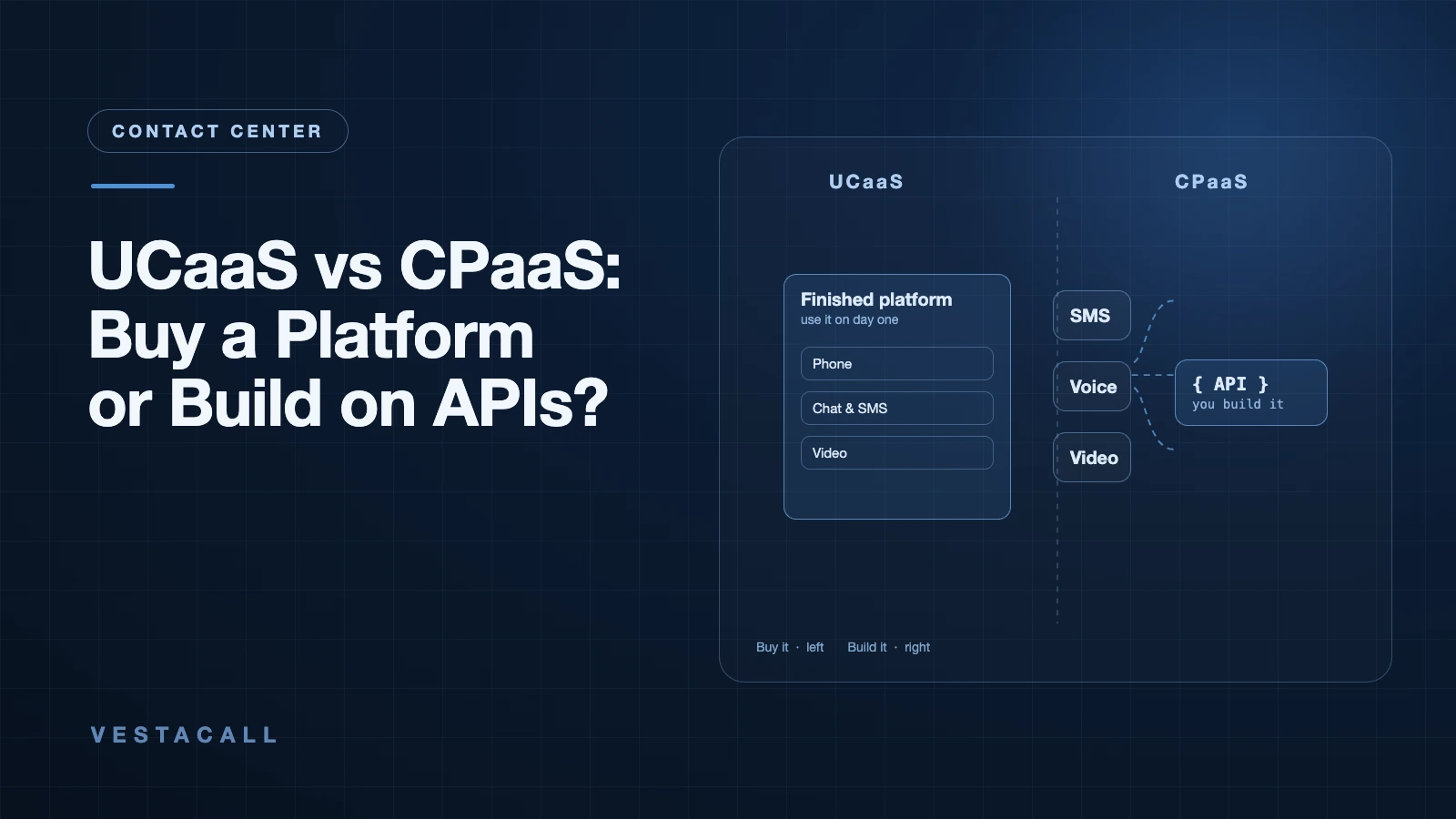
The quickest way to understand UCaaS versus CPaaS: one you buy, the other you build.
That’s not a slogan — it’s the entire distinction, and it decides which one you need before you look at a single feature list. Everything else is detail.
UCaaS: a finished product
UCaaS — Unified Communications as a Service — is a complete communications platform your staff use out of the box. Phone, team chat, video, SMS, one login, one admin console. You sign up, configure it, and people start calling. No code.
It’s a big, established market. Fortune Business Insights put UCaaS at about $78.15 billion in 2026, growing around 17% a year. That scale makes sense — nearly every business needs a way for its people to communicate, and a finished platform is how most of them get it. If you want the deeper breakdown, the UCaaS guide covers it.
CPaaS: building blocks
CPaaS — Communications Platform as a Service — is the opposite shape. It’s not a product you use; it’s a set of APIs you build on. A developer gets keys and writes code to send an SMS, place a call, or embed video inside their own application.
Think of the ride-share app that masks driver and rider numbers, or the bank sending a one-time passcode by text. The communication is a feature buried inside a larger custom product — and it got there because an engineer wrote it against a CPaaS API.
CPaaS is smaller but growing faster. Grand View Research put it around $31.2 billion in 2026, expanding at roughly 28.7% a year — quicker than UCaaS, because embedding communications into software is a newer and still-accelerating practice.
Side by side
| UCaaS | CPaaS | |
|---|---|---|
| What it is | A finished platform | Developer APIs |
| Who uses it | Business staff | Software developers |
| Setup | Configure and go | Write and maintain code |
| Pricing | Per user, predictable | Per usage (message, minute) |
| You get | What’s built | What you build |
| Market (2026) | ~$78B | ~$31B |
Notice they aren’t really competitors. One answers “how do our people communicate?” The other answers “how do we put communication inside the thing we’re building?” Different questions, different buyers inside the same company.
The test
Forget the acronyms. Ask one thing:
Do you want working communications, or do you want to build communications into your own software?
If you want a phone system, chat, and video that staff can use today — UCaaS. Buy it, configure it, done.
If you’re an engineering team embedding calling or messaging into a product you ship — CPaaS. You’ll write and maintain it, and in return you get exactly what you design.
And yes, a company can need both: UCaaS for how employees talk, CPaaS for the SMS alerts baked into the app it sells. That’s not a contradiction — they live in different parts of the business.
Where VestaCall fits — plainly
VestaCall is a UCaaS and CCaaS platform, not a CPaaS API provider. We deliver finished calling, messaging, and contact-center products your team uses on day one — not endpoints your developers build against.
So if your question is “which do I need,” here’s the honest filter: if you’d rather configure a platform than staff an engineering project, you want UCaaS, and that’s what we do. If you genuinely need to embed communications into custom software by API, that’s a different category — and we’ll tell you so rather than pretend otherwise.
Not sure which side of the line you’re on? Talk to the VestaCall sales team and we’ll place it honestly — or read the UCaaS guide to pin down the platform side first.