Two acronyms, one letter apart, and a surprising number of sales calls that start with someone buying the wrong one.
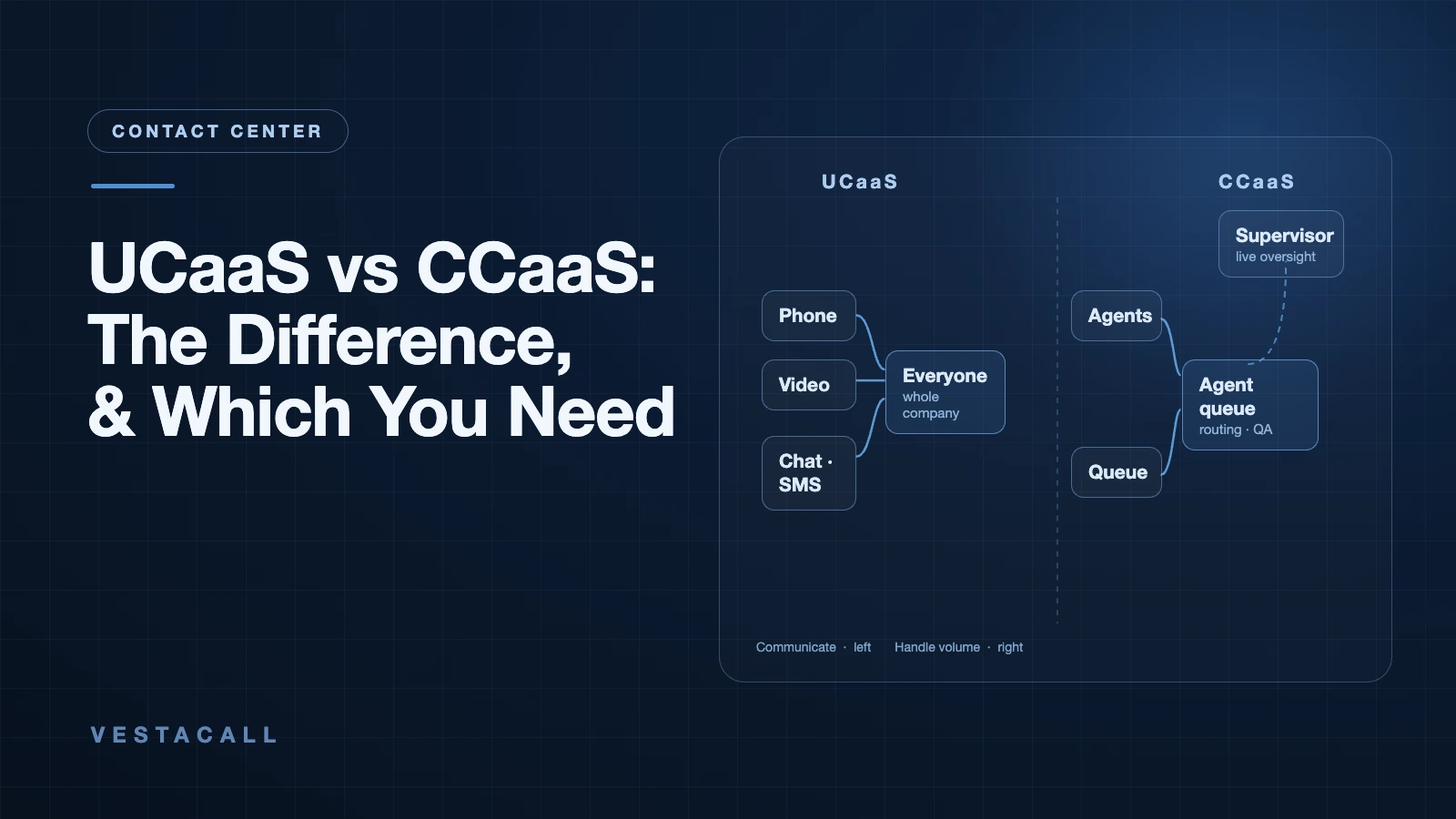
Here’s the short version before the detail. UCaaS is how your company communicates. CCaaS is how your queue runs. If you remember nothing else, remember that.
Now the longer version — because the overlap is where people get confused, and where money gets wasted.
UCaaS: communication for everyone
UCaaS — Unified Communications as a Service — is the cloud platform that gives every employee a phone, team chat, video meetings, and SMS in one place. One login, one bill, one set of numbers, instead of a PBX plus Slack plus Zoom plus some texting tool nobody remembers buying.
It’s aimed at the whole organization. The receptionist, the engineers, the sales team, the CEO — everyone gets the same communication stack. Nobody’s sitting in a queue; they’re just calling, messaging, and meeting as the day demands. If you want the full breakdown, the UCaaS guide goes deep.
This is a big market, and growing. Per Fortune Business Insights, the global UCaaS market was about $78.15 billion in 2026, heading toward $276.9 billion by 2034 at roughly a 17% annual rate. That scale makes sense — almost every business communicates.
CCaaS: operations for a queue
CCaaS — Contact Center as a Service — is narrower and deeper. It’s built for the teams whose entire job is calls: support, sales, collections. The people who sit in a line and take whatever comes next.
Those teams need things a normal phone system has never heard of. Queues, so forty callers can wait in order. Skills-based routing, so the billing question reaches a billing agent. (That routing engine has a name — the ACD.) Quality monitoring, so supervisors can coach instead of guess. That’s CCaaS, and VestaCall delivers it through the Cloud Contact Center.
The CCaaS market is smaller — about $8.33 billion in 2026, says Fortune Business Insights — but growing at a near-identical 17.4% a year. Smaller because only a subset of businesses run a contact center. Growing because the ones that do are abandoning on-premise hardware.
Side by side
| UCaaS | CCaaS | |
|---|---|---|
| Built for | Everyone in the company | Agents working a queue |
| The core job | Communicate | Handle call volume |
| Signature features | Calls, chat, video, SMS | Queues, routing, QA, workforce management |
| Typical buyer | A marketing agency | A 50-seat support team |
| Market size (2026) | ~$78B | ~$8B |
Notice the markets aren’t competing — they’re stacked. UCaaS is roughly ten times the size because nearly every business communicates, while only some run a contact center. The two categories solve different problems for different people inside the same building.
The test that settles it
Forget the acronyms for a second. Ask one question:
Does anyone on your team sit in a line, waiting for the next call to come to them?
If no — if calls are something people make and take as part of a broader job — you want UCaaS. A phone system, chat, and video for the company. Done.
If yes — if you have people whose whole shift is a queue — you want CCaaS for them. The call volume is the job, and a job that’s a queue needs routing and supervision that UCaaS doesn’t include.
And here’s the part people miss: plenty of companies answer yes and no at the same time. The support floor is a queue (CCaaS). Everyone else is just communicating (UCaaS). That’s not a contradiction — it’s the normal shape of a growing business.
Why “both” doesn’t have to mean two vendors
If you need both, the obvious move is to buy a UCaaS product and a separate CCaaS product and wire them together. It’s also the move that leaves you with two admin consoles, two bills, two support lines, and a seam down the middle where numbers and call data don’t quite line up.
They don’t have to be separate. VestaCall runs unified communications and the contact center on one platform — business phone, messaging, and video for the whole company, plus routing, QA, and workforce management for the agents who need them. From $19 per user per month, with no self-serve trial to activate: buying is sales-led, so you get a scoped setup rather than a guess.
So which do you need? Run the test. If you’re still not sure — or if the answer is “both” and you’d rather not glue two vendors together — talk to the VestaCall sales team, or read the CCaaS guide to pin down the contact-center side first.