A caller with a billing problem lands on an agent trained only in tech support. The agent listens, apologizes, and transfers them. New queue, new wait, and the caller repeats the whole story to someone new.
That’s the failure skills-based routing exists to prevent. And it’s more expensive than it looks.
What skills-based routing actually is
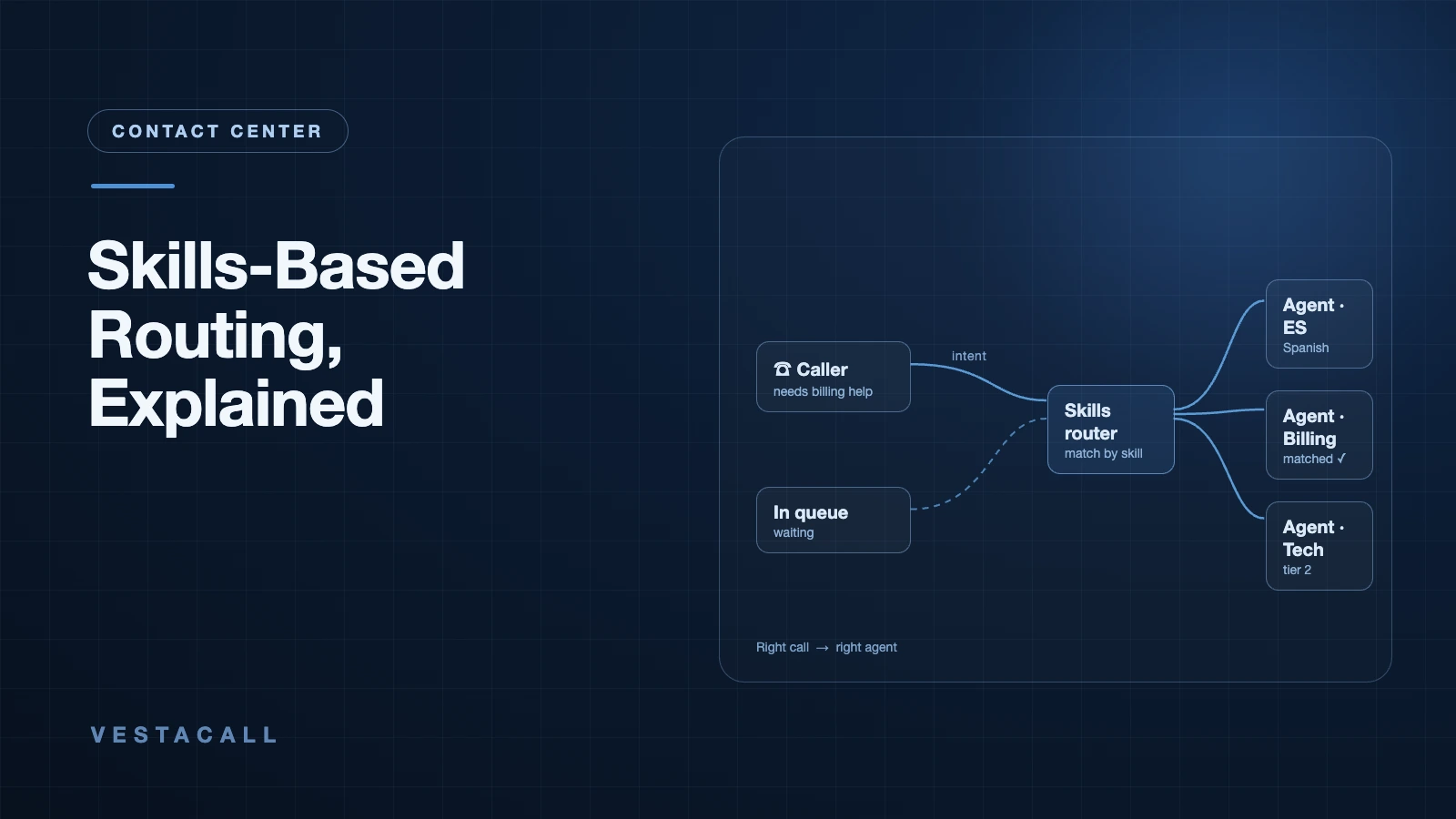
Skills-based routing matches each incoming call to an agent by their skills — language, product knowledge, seniority — instead of just handing it to whoever’s free next. The ACD reads what the caller needs and what each available agent is tagged to handle, then connects them to the best fit.
Plain routing asks one question: who’s free? Skills-based routing asks a better one: who’s free and right for this call?
How it works, step by step
It’s less mysterious than it sounds.
First, every agent gets skill tags — “Spanish,” “billing,” “tier-2 technical,” “enterprise accounts.” Then the caller’s need gets identified, usually through an IVR menu or the number they dialed. The routing engine matches the two and places the call — or, if no matching agent is free, holds it in a call queue for the right person rather than dumping it on the wrong one.
That last part is the whole trade-off in one sentence. The system would rather hold you a few seconds longer for the right agent than connect you instantly to the wrong one.
Why it matters: first call resolution
Here’s the payoff, and it’s measurable.
The biggest driver of first call resolution — issues solved on the first contact — is whether the agent can actually solve the problem. SQM Group research points to agent knowledge gaps as a leading cause of failed first-call resolutions. Put differently: a lot of callbacks happen simply because the right call reached the wrong agent.
Skills-based routing attacks that directly. A specialist handling calls they’re equipped for resolves them at a higher rate than a generalist handling the same calls. Better matching, more first-time fixes, fewer callbacks.
And fewer transfers, which matters more than efficiency. SQM Group found customer satisfaction drops each time a call is transferred — so every avoided transfer isn’t just faster, it’s a customer who stays happier. Routing the call right the first time protects CSAT and cost at once.
The honest trade-offs
I’m not going to pretend this is free.
Skills-based routing can make a caller wait slightly longer, because the system holds them for the right agent instead of the next one. For most issues that’s a good trade — a short extra wait beats a transfer and a callback — but it’s a real cost, not zero.
And it lives or dies on your skill data. Tag agents wrong, or let the tags go stale as people learn new things, and the system will route calls to the wrong people with total confidence. Skills-based routing rewards a well-maintained setup and punishes a sloppy one. Actually, that understates it — bad skill data is worse than no routing, because it’s wrong on purpose.
Do you need it?
Simple test: do your agents have different skills?
If everyone can handle everything equally, skill-based routing adds little — plain call queue order is fine. But the moment you have specialists — a language, a product, a senior tier — routing by skill stops those calls from landing on someone who can only escalate. Even a small team with mixed expertise gets the benefit.
VestaCall handles skills-based routing through its smart routing and IVR, part of the cloud contact center — build the skill tags and rules from the dashboard, no vendor ticket required.
So: are your calls reaching the agents who can actually solve them, or just the ones who happen to be free? If you’re not sure, that gap is worth closing. Talk to the VestaCall sales team about setting up routing that matches your team’s skills — or read the CCaaS guide to see where routing fits in the bigger picture.