Start with the number that ends most of these debates, then let’s complicate it.
Moving a contact center from on-premise to the cloud cuts five-year total cost of ownership by roughly 25–45%, according to Aberdeen Group research — mostly from the hardware, maintenance, and IT staffing you stop paying for. That’s the headline, and it’s real.
It’s also not the whole story. So before you treat “go cloud” as settled, here’s the honest version — including the parts the vendor decks skip.
Where the on-premise money actually goes
An on-premise contact center is a capital project before it’s a phone system.
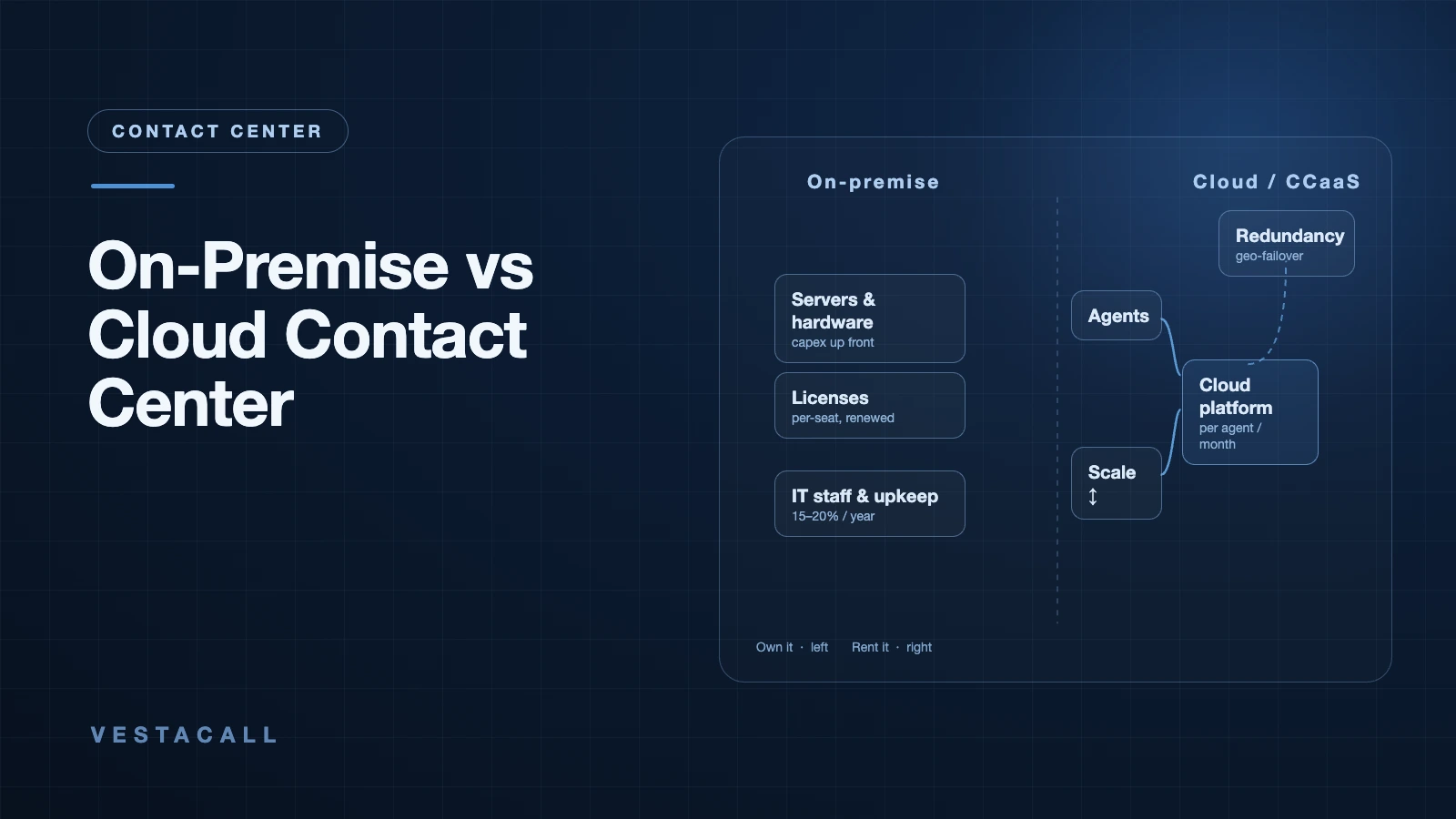
You buy servers. You buy telephony hardware and the licenses to run it. You pay to install it, and you pay people to keep it running. Deloitte’s 2023 contact center infrastructure research put the upfront capital outlay for mid-to-large on-premise deployments in the hundreds of thousands of dollars — before a single call is answered — with another 15–20% of that recurring every year just for maintenance.
Then there’s the hidden line item: your own IT team. Someone patches the servers. Someone handles the failover testing. Someone is on call when the hardware fails at 2am. That labor doesn’t show up on the purchase order, but it’s on the payroll.
None of this means on-premise is wrong. It means on-premise front-loads cost and ties it to hardware you own and maintain. Which is exactly what cloud unbundles.
What cloud changes
Cloud contact center — CCaaS — turns that capital project into an operating cost. No servers. No telephony hardware. You pay per agent per month, and the provider runs the infrastructure, the updates, and the redundancy.
The market has decided this is the direction. Fortune Business Insights put the CCaaS market at about $8.33 billion in 2026, heading to $30.15 billion by 2034 at a 17.4% annual rate. That growth isn’t enterprises adopting something new — it’s businesses of every size retiring on-premise hardware.
The practical wins are real:
- No capex. You’re not buying servers you’ll depreciate.
- It scales both ways. Add agents for a seasonal spike, drop them after. Try that with racked hardware.
- Updates and redundancy are the provider’s problem. Geo-redundant failover that a single-site on-premise room can’t match without serious money.
- Routing you can change yourself. Rebuild a queue or an IVR from a dashboard instead of a vendor visit — see smart routing and IVR.
The part vendors skip
Here’s where I’ll argue against the easy version of this article.
Cloud isn’t automatically cheaper, and anyone who tells you it is hasn’t read the contract. WWT analysis found that unoptimized cloud contact centers can run 15–25% higher than planned, with the cost crossover against on-premise landing around three to five years. The savings are real — but they’re conditional on a deployment that’s actually optimized and a pricing model that matches your usage.
And the pricing model is where people get burned. A Talkdesk analysis found consumption-based pricing can run roughly 30% more than named-user pricing for the same 1,000 agents. Same platform, same headcount, very different invoice — purely from how you’re billed. That’s the kind of surprise that sends a minority of cloud adopters partway back to on-premise, not because the technology failed, but because the bill didn’t match the forecast.
So model your pricing structure, not just the sticker. Ask how you’re charged when volume spikes. Read the SLA exclusions.
When on-premise still wins
Rare, but real: highly regulated environments that mandate on-premise or air-gapped telephony, and sites with no reliable internet. If a regulator requires the calls stay on hardware you physically control, that requirement beats any TCO spreadsheet. For almost everyone else, that’s not the situation.
(If you’re weighing the same question for a phone system rather than a contact center, the cloud PBX vs on-premise breakdown covers that side.)
So which one?
For most contact centers in 2026, cloud wins — lower multi-year TCO, no hardware to own, redundancy you’d struggle to build yourself. But “most” isn’t “all,” and “usually cheaper” isn’t “cheaper no matter what you sign.”
Do the honest math: your capex and IT labor on the on-premise side, your modeled usage on the cloud side — not the headline rate. If cloud still wins, which it usually does, move. If you want someone to run that math with you against your actual numbers, talk to the VestaCall sales team, or read the CCaaS guide first.