Nobody checks ten thousand prefixes by hand. So every wholesale carrier runs software that picks a route for each call automatically. That software is least-cost routing, and whether it’s tuned well is the difference between a supplier you trust and one whose calls randomly go bad.
What LCR does
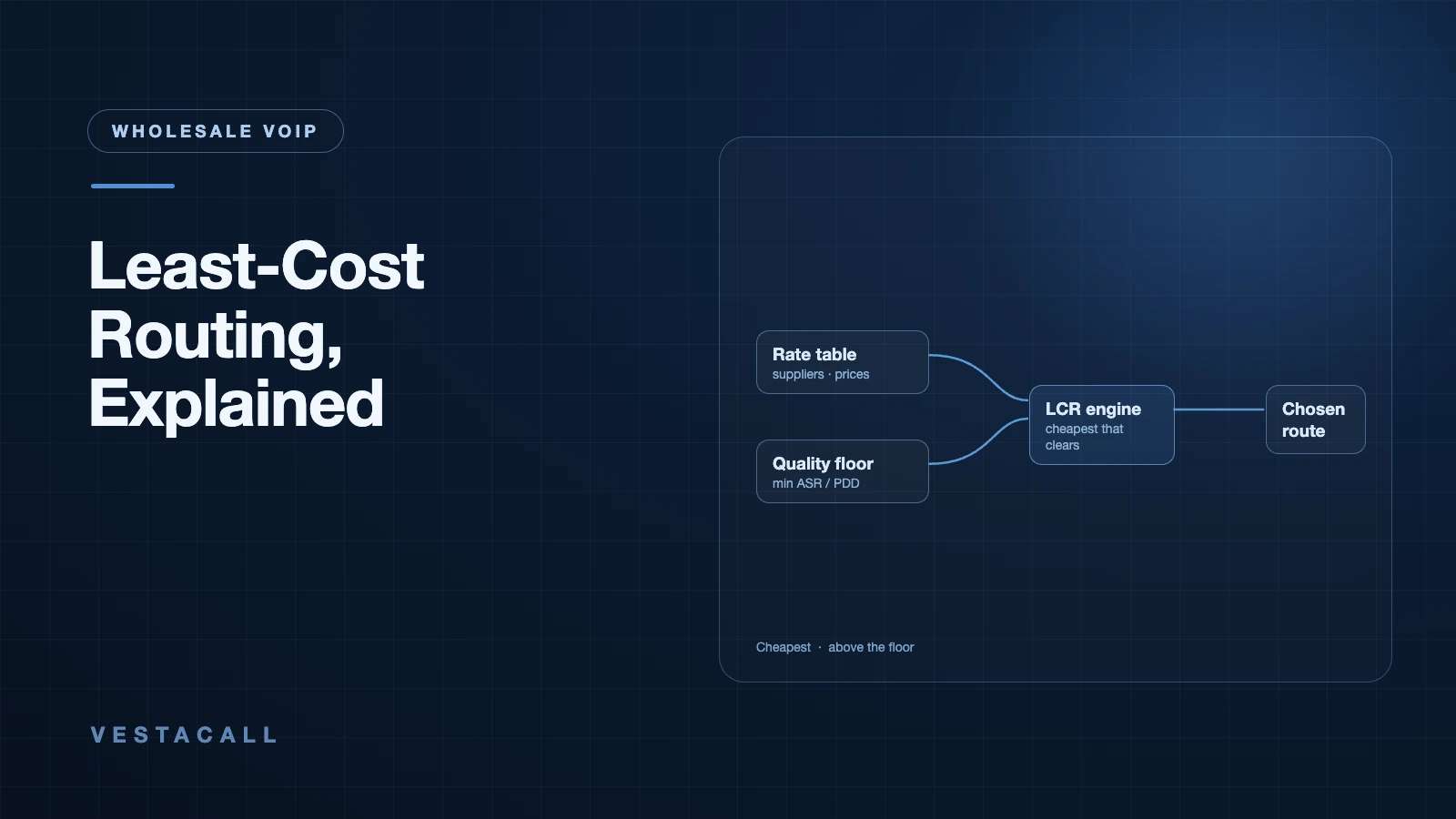
Least-cost routing holds a rate table — suppliers and their per-minute rates, for every destination — and, for each call, picks the cheapest available route. If that route is congested or failing, it fails over to the next-cheapest. Call by call, prefix by prefix, automatically.
That’s necessary and normal. No one prices a global rate deck and then routes by hand. The question isn’t whether a supplier uses LCR. It’s what their LCR optimizes for.
Where it goes wrong
Point an LCR engine at price alone and it does exactly what you told it: finds the cheapest route, every time.
The cheapest route is usually the worst one. It’s a grey route hopped through extra intermediaries, each of which shaves the rate and adds damage — more PDD, a real chance of dropping the caller ID, lower ASR. The call technically completes often enough to look fine in aggregate, while quietly failing on the destinations you care about.
This is why a “cheaper” supplier can sound worse. Nothing is broken. Their LCR is just doing its job — for a job you wouldn’t have given it.
Good LCR has a floor
The fix isn’t to abandon LCR. It’s to give it a quality floor.
A quality floor is a minimum standard the engine won’t route below — a completion rate it won’t dip under, a carrier interconnect directness it insists on. With a floor, the LCR still picks the cheapest route that clears the bar, and drops a cheap route automatically the moment it starts failing. You get most of the savings without the cliff.
The whole craft of wholesale routing lives in that balance: shave cost where you safely can, refuse to route below a standard you’ll stand behind. A supplier who talks only about price has told you their floor is the floor.
What to ask your supplier
One question cuts through the sales pitch: “How does your LCR balance price against quality?”
A good answer describes quality floors, per-destination monitoring, and automatic failover when a route degrades. A bad answer is some version of “we always get you the best rate” — which means they’re routing you to the bottom and hoping you don’t check.
Then verify it the only way that’s real: watch your per-destination ASR and PDD after you start sending volume. If quality holds, the floor is real. If it sags, the LCR is chasing price with your traffic.
VestaCall routes with quality floors rather than chasing the bottom, which is the difference you hear on the CLI/NCLI routes. Want to see how your destinations hold up under real volume? Talk to the wholesale team.