A rate deck looks like the most honest document in wholesale voice. It’s a spreadsheet. Numbers don’t lie, right?
They don’t lie. They just don’t tell you the whole truth unless you know which columns to actually read.
What’s in the spreadsheet
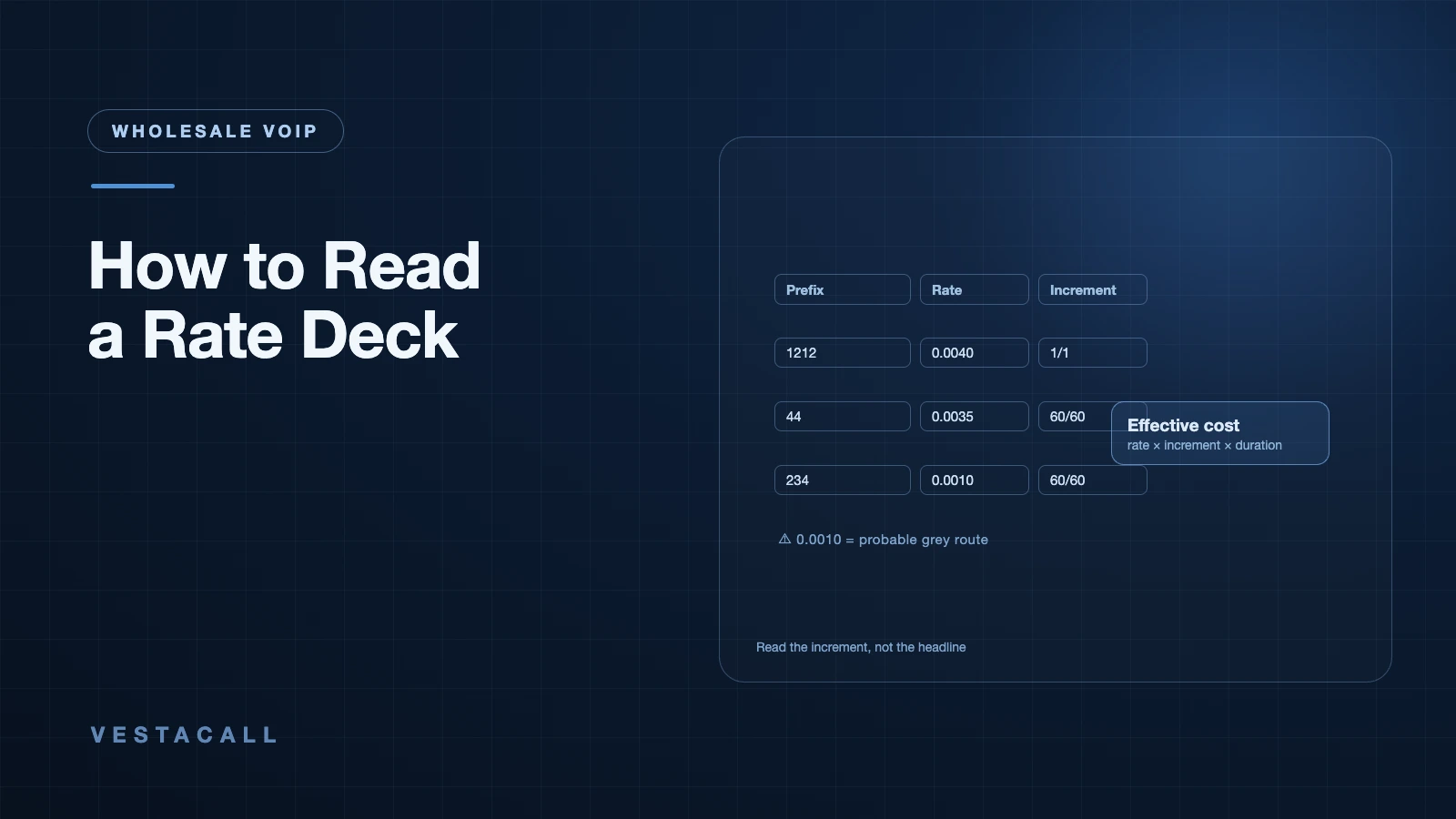
A rate deck is a carrier’s price list: one row per destination, each mapping a dialing prefix (like 1212 for New York, 44 for the UK) to a per-minute rate and a billing increment. There’s an effective date at the top, because these numbers move constantly.
Most people open a deck, scan the per-minute column, and decide. That column is exactly the one that fools you.
The increment is where the money hides
Two decks quote the same destination. Deck A is a hair cheaper per minute. Deck A wins — until you read the increment column.
Billing increments say how calls are rounded. 1/1 bills per second: a 23-second call costs 23 seconds. 60/60 rounds every call up to a whole minute: that same 23-second call costs a full minute, and a 61-second call costs two.
If your traffic is full of short calls — dialer campaigns, notifications, missed-call-backs — 60/60 rounding can double your effective cost. Deck A’s lower headline rate loses to Deck B’s per-second billing, badly. The sticker price was never the price.
So the first real column isn’t the rate. It’s the increment.
Compare the prefixes you dial, not the deck
The second trap is averages. A deck can look great overall and be terrible on the one country that makes up half your minutes.
Don’t evaluate a deck as a whole. Pull your own traffic, find your top prefixes, and compare those rows across suppliers — effective cost, including the increment, for the destinations you actually dial. A deck’s headline competitiveness is marketing; your prefix-level effective cost is the invoice.
When a rate is too good
Here’s the tell that saves you real money: a rate that’s dramatically below everyone else for a destination isn’t a bargain. It’s a route.
Suspiciously cheap almost always means a NCLI or grey route behind the number — stripped caller ID, high PDD, ASR that collapses under volume. You’ll save on the deck and lose it back in calls that don’t connect. On the destinations that matter, treat an outlier-low rate as a warning, not an opportunity.
Reading a deck, in order
- Check the effective date. Stale decks quote prices that no longer hold.
- Read the increment first. 1/1 vs 60/60 can outweigh the rate on short calls.
- Compute effective cost on your top prefixes — rate plus increment plus your real durations.
- Flag outlier-low rates as probable grey routes and test them before trusting them.
- Then compare suppliers — on effective cost for the destinations you dial, not the headline average.
VestaCall publishes wholesale termination rates with the increment made explicit, so you can compare on effective cost instead of a headline number. Want to run your top prefixes against the current deck? Talk to the wholesale team.