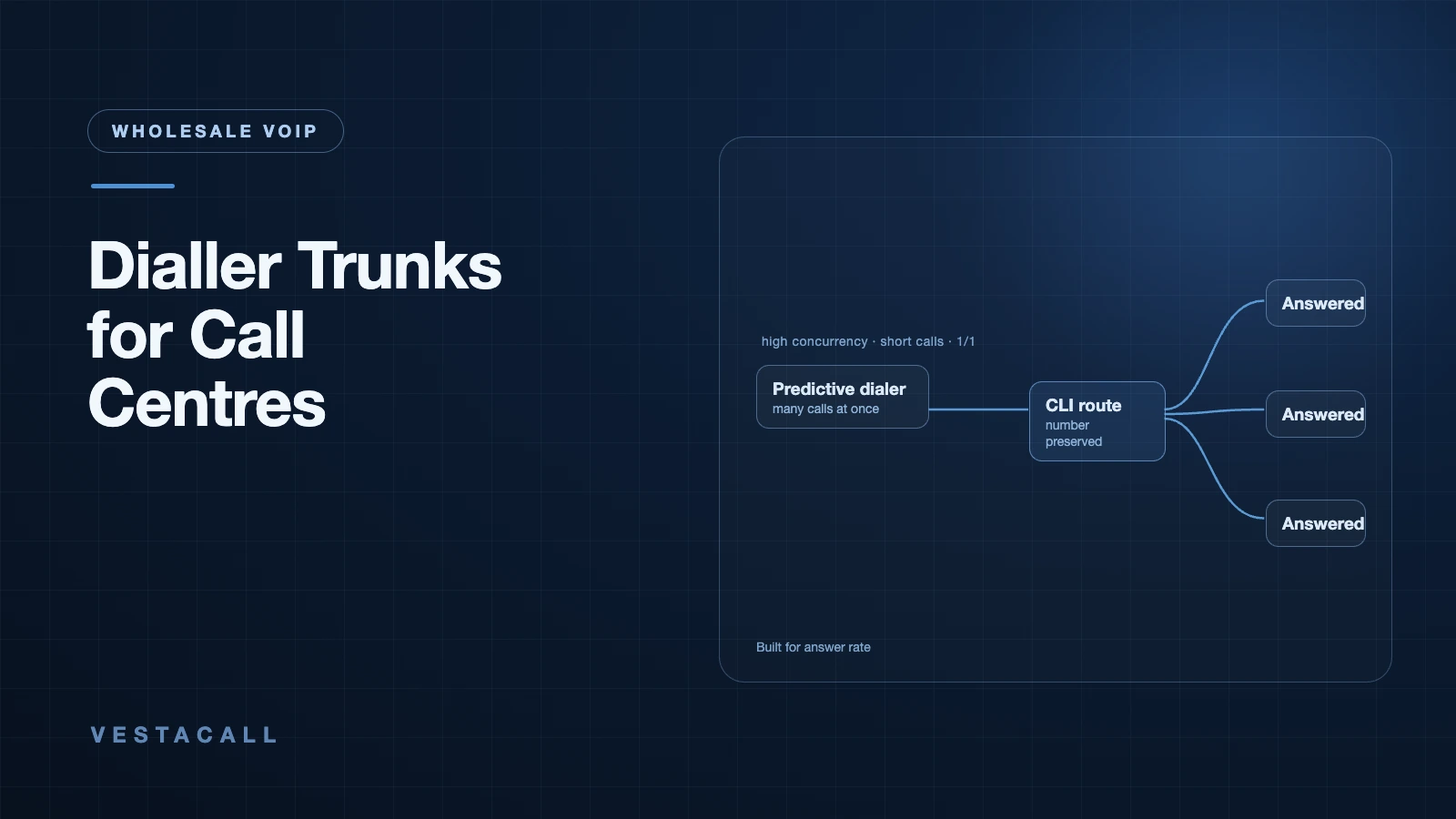
An office SIP trunk and a dialler trunk are the same technology pointed at completely different problems. Put a predictive dialer on a trunk built for office calls and it falls over by mid-morning — blocked calls, dead air, answer rates in the gutter.
Outbound at scale is a brutal, specific traffic pattern. Here’s what it actually demands.
The traffic is nothing like normal calling
A predictive dialer doesn’t make calls the way a person does. It fires many at once, dialing ahead of agent availability so a live answer is waiting the instant an agent frees up. Most of those attempts are short — no-answers, quick connects, voicemail drops. And the entire economics of the floor rests on one number: how many people answer.
So a dialler trunk has to handle, all at once: huge concurrency, a flood of short calls, and answer rate as the metric that pays the bills. Four things follow directly from that.
1. Concurrency sized to the dialer, not the agents
A fifty-agent floor is not a fifty-channel trunk. Because the dialer dials ahead — several attempts per available agent — peak concurrency runs into the hundreds. Size the trunk to the dialer’s peak simultaneous attempts, with headroom for ramp. Under-provision and calls block exactly when the campaign is hottest.
2. Per-second billing, not per-minute rounding
Dialler traffic is short calls by nature. A 60/60 billing increment rounds every unanswered attempt and quick connect up to a full minute — and on high volume, that rounding can double or triple your effective cost.
For outbound at scale, per-second (1/1) billing isn’t a nice-to-have. It’s one of the largest levers on the whole bill. Insist on it.
3. CLI routes, because unknown numbers don’t get answered
You can run the best list and the best agents, and still fail if the recipient’s phone says “unknown.” People answer numbers they recognize. A CLI route preserves your caller ID; an NCLI route strips it to save money and quietly kills your answer rate.
On a dialler, CLI isn’t a routing preference. It’s the campaign. (And it ties into STIR/SHAKEN — mangled caller ID gets flagged as spam, which is the same wound twice.)
4. Low PDD, so the dialer isn’t waiting on silence
Post-dial delay — the gap before ringback — is poison for a dialer. Long PDD means the system sits on dead air before it knows whether a call connected, which throws off pacing, creates abandoned calls, and leaves agents waiting. Low PDD is a sign of direct carrier interconnects, and it’s what lets the dialer run tight.
What this adds up to
A dialler trunk is a SIP trunk tuned for the worst traffic pattern in voice: high concurrency, short calls, answer-rate-or-die. The spec writes itself — big concurrency, 1/1 billing, clean CLI, low PDD, over direct routes you can watch per destination.
VestaCall provisions wholesale SIP trunking for exactly this kind of outbound load, on CLI routes graded for quality. Running a dialler and watching your answer rates sag? Talk to the wholesale team with your peak concurrency and top destinations.