Your outbound answer rate drops. Same list, same agents, same script — but fewer people pick up. Before you blame the list, check what number you’re showing up as.
Odds are your supplier quietly moved your traffic to a cheaper route.
The one difference that matters
In wholesale voice, routes come in two flavors, and the difference is caller ID.
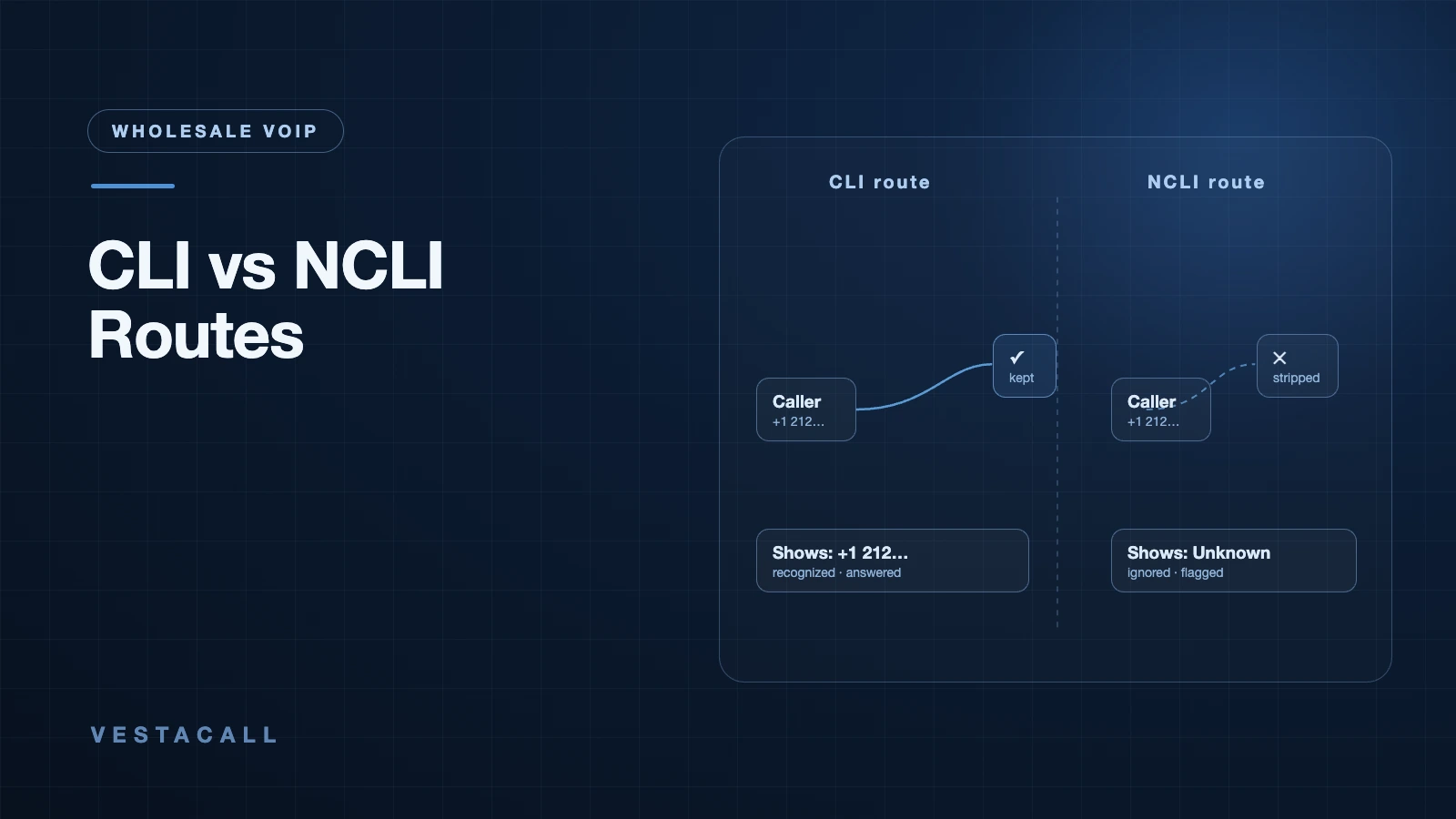
A CLI route (Calling Line Identification) passes the caller’s real number through to the recipient. Their phone rings and shows a recognizable number. They answer.
An NCLI route (non-CLI) strips or replaces that number to save money. Their phone rings and shows “unknown,” or some random number that isn’t you. They don’t answer.
That’s it. One letter of difference in the acronym, a world of difference in whether anyone picks up.
Why NCLI is cheaper — and what you’re really paying
NCLI routes reach the destination through cheaper, less direct carrier paths that don’t bother preserving the CLI. Dropping that guarantee is exactly what lets the per-minute price fall.
But the saving is an illusion on any traffic where answer rate matters. Three things go wrong at once:
- Answer rates fall. People don’t answer unknown numbers. Full stop.
- Spam filters bite. Missing or faked caller ID is what STIR/SHAKEN analytics flag. NCLI calls get labeled “Spam Likely” more often.
- Quality usually sags too. The same cheap routing that strips CLI tends to add PDD and drag ASR down — because it’s the same grey-ish path doing all three.
You bought a cheaper minute and lost the connection. The real cost is per answered call, and on that math NCLI often costs more.
When NCLI is actually the right call
NCLI isn’t evil — it’s a tool. There’s traffic where nobody needs to see a number:
- Machine-to-machine notifications where a human never decides to answer.
- Internal testing and load traffic.
- Genuinely low-value volume where a few points of answer rate aren’t worth the premium.
For that traffic, paying CLI prices is wasteful. Match the route to the value of the call. The error is using NCLI for sales and support, where a recognizable number is the whole point.
How to not get downgraded without knowing
Here’s the quiet problem: you can pay for CLI and get NCLI. A supplier under margin pressure can route your traffic cheaper and pocket the difference, and you won’t see it in the invoice — only in your answer rate.
So verify what reaches the other end. Place test calls to numbers you control and check what caller ID actually displays. If a “CLI” route is delivering unknown numbers, you’re being downgraded. Clean carrier interconnects preserve CLI; grey paths don’t.
VestaCall separates CLI and NCLI routes explicitly, so you buy the tier you actually need and get the one you paid for. Want to test what your number looks like on the other end? Talk to the wholesale team.