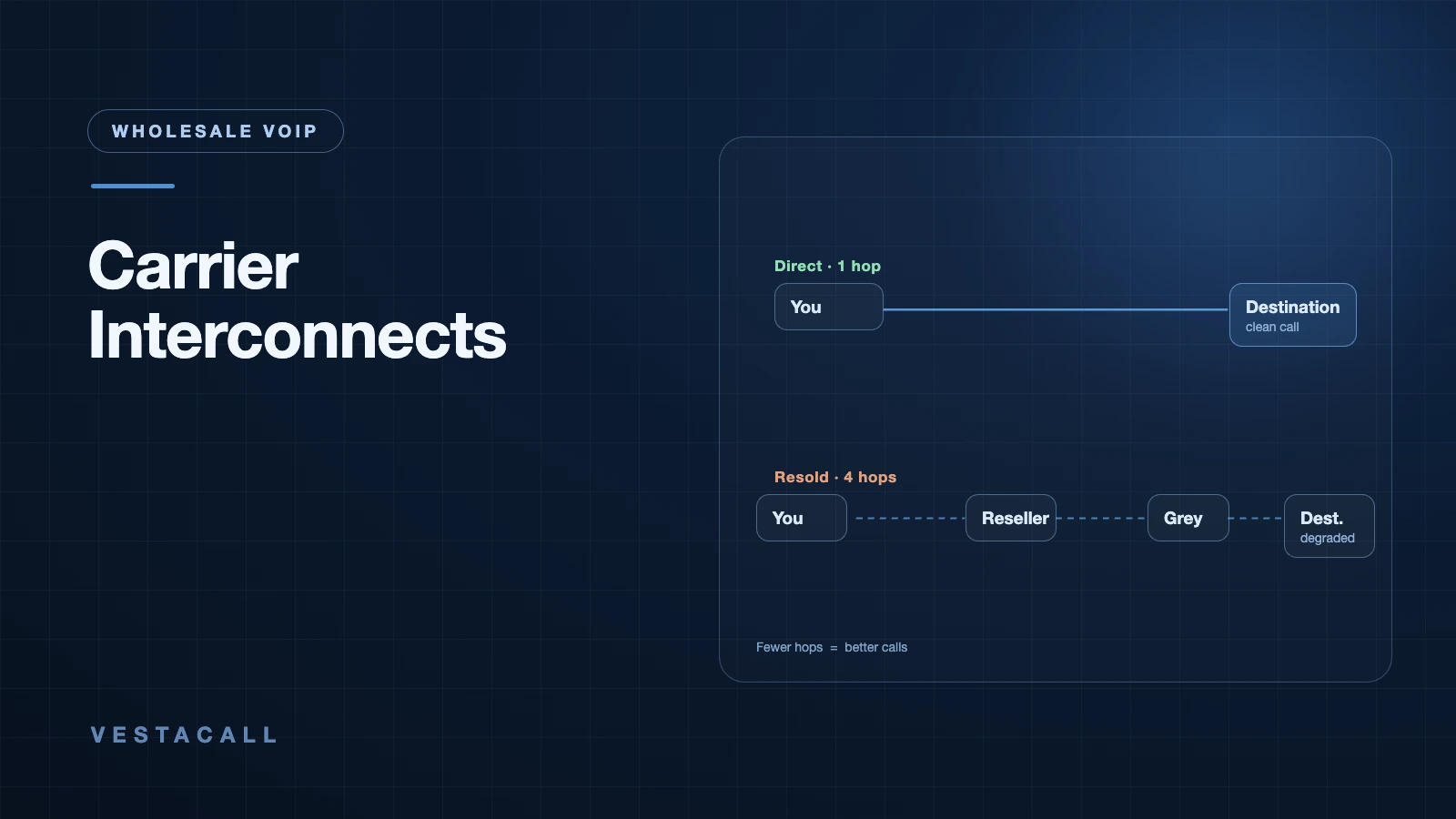
Strip away the rate decks, the portals, and the sales language, and wholesale voice quality comes down to one physical fact: how many networks your call touches between you and the person you’re calling.
Fewer is better. That’s the whole guide. Everything else is detail — but the detail is worth knowing, because it’s how you tell who’s selling you directness and who’s selling you a story.
What an interconnect actually is
A carrier interconnect is the direct connection — and the commercial agreement behind it — between two carriers that lets them exchange voice traffic. Two networks agree terms, swap technical details (IPs, codecs, capacity), and light up a direct path so calls pass between them without a middleman.
It’s not a SIP trunk. A trunk connects you to a carrier. An interconnect connects a carrier to another carrier. Your trunk’s traffic rides across a chain of interconnects to reach its destination — and the shape of that chain is your call quality.
Why directness decides everything
Picture two paths for the same call.
Path one: your carrier has a direct interconnect to the destination’s network. One hop. The caller ID arrives intact, ringback comes back fast, the call completes.
Path two: your “carrier” resold the route to a cheaper one, who resold it again, who handed it to a grey-market aggregator. Four hops. At each, the caller ID can get stripped, post-dial delay stacks up, and the call can quietly fail — so ASR sags.
Same destination. Completely different call. The difference is entirely the number of hands it passed through. This is why a Tier-1 route outperforms a grey route: not magic, just directness.
The tell when someone’s not direct
Every supplier claims direct routes. The claim is free. So don’t argue about it — measure it.
A route that’s secretly hopped through intermediaries leaves fingerprints:
- High PDD — a long, growing pause before ringback.
- Bad CLI — your number arriving stripped, wrong, or flagged.
- Volatile ASR — completion that swings, or a route that suddenly dies when a loophole closes.
When a “direct” route shows this cluster, it isn’t direct, whatever the rep said. Per-destination monitoring of ASR and PDD turns the sales claim into a fact you can check.
What you’re paying for when you pay more
Direct interconnects cost money to build and keep — relationships, capacity commitments, engineering. Resold grey paths skip all that by piggybacking on someone else’s work, which is exactly why they’re cheaper and worse.
So the premium on a direct route isn’t markup for its own sake. It buys low delay, preserved caller ID, stable completion, and routes that don’t vanish overnight. On any traffic where answer rate matters, paying for directness is usually cheaper per connected call — the only unit that actually pays you back.
The question to ask
You don’t need to audit a supplier’s network. You need to ask one thing and then verify it: “How direct is your route to the destinations I dial — and will you show me per-destination ASR and PDD?”
A direct supplier answers plainly and shows you the numbers. An indirect one talks about price.
VestaCall grades its CLI/NCLI routes on exactly this — directness you can see in the completion and delay numbers, not just hear in the pitch. Want to test how direct your key destinations really are? Talk to the wholesale team.