Two suppliers quote you the same country. One is half the price of the other. Same destination, same minutes — so the cheap one wins, right?
That instinct is how most people lose money on wholesale voice. Let’s walk through why.
What “A-Z” actually means
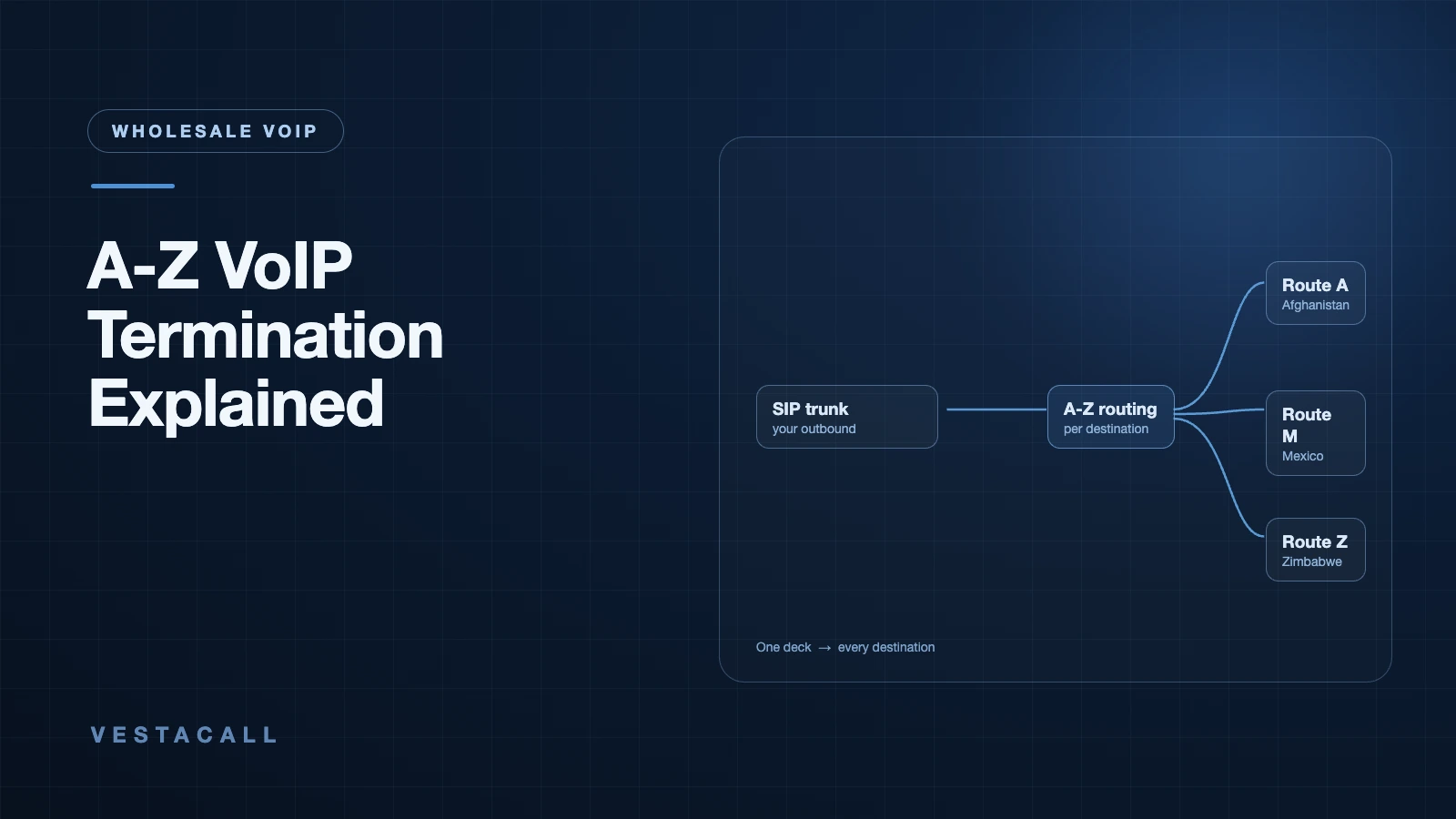
A-Z termination is a wholesale voice service that delivers outbound calls to any destination in the world — “A to Z,” Afghanistan to Zimbabwe. Instead of negotiating a route for each country, you get global coverage on a single rate deck, priced per destination.
That’s the appeal: one supplier, one deck, the whole planet. A reseller can offer global outbound without signing carrier deals country by country. A call centre can run an international campaign without hunting for a Mongolia route at 2am.
The catch is that “reaches everywhere” says nothing about how well it reaches anywhere.
How it’s priced — and why the headline rate lies
Each row of an A-Z rate deck maps a prefix (like 1212 for New York) to a per-minute rate and a billing increment. People compare the per-minute rate and stop there. That’s the mistake.
Two things turn a “cheap” rate into an expensive one:
- The billing increment. A rate billed 60/60 — rounding every call up to a full minute — costs far more on short calls than the same rate billed 1/1 per-second. On dialer traffic full of 15-second calls, 60/60 can double your real cost.
- The route behind the rate. A low rate for a destination is often a cheap NCLI or grey route in disguise. You save on the per-minute rate and lose it back in calls that never connect.
Reading a rate deck means comparing effective cost per destination — rate plus increment plus quality — not the sticker number. (There’s a full walkthrough in how to read a rate deck.)
The three numbers that decide quality
Forget the price for a second. A route lives or dies on three metrics, all readable off the CDRs:
ASR — Answer-Seizure Ratio. The share of call attempts that actually connect to an answered call. A route with a low or sliding ASR is failing calls, full stop.
PDD — Post-Dial Delay. The pause between finishing dialing and hearing ringback. Low on a direct route, painful on one hopped through four intermediaries — and long PDD makes callers hang up, which drags ASR down with it.
CLI vs NCLI. Does the route preserve the caller’s number or strip it? CLI routes get answered far more often because the recipient sees a real, recognizable number. NCLI routes are cheaper and show up as unknown — murder on answer rates.
That’s the whole game. A good A-Z supplier gives you strong ASR, low PDD, and clean CLI on the destinations you actually dial. A bad one gives you a beautiful headline rate and terrible numbers underneath.
So — the cheap supplier?
Back to the two quotes. The expensive one is probably a direct CLI route over proper carrier interconnects. The cheap one is probably grey — stripped caller ID, high PDD, answer rates that collapse the moment you push volume.
The cheap minute you bought is worthless if the call doesn’t connect. Effective cost isn’t the per-minute rate; it’s the cost per completed call. On that math, the “expensive” route is often cheaper.
How to actually buy A-Z termination
Don’t buy the deck. Buy the destinations you dial.
Pull your own traffic, find the prefixes that make up most of your minutes, and test those on a trial — watch ASR, PDD, and CLI on your real numbers, not a demo. A supplier can have a great deck overall and a dead route on the one country that matters to you. The average tells you nothing; the prefixes you dial tell you everything.
VestaCall provides wholesale A-Z termination with routes graded on quality per destination, not chased to the floor on price. Want to test it against the prefixes you actually run? Talk to the wholesale team and bring your top destinations.